Many SMEs (small and medium-sized enterprises) know they "need to digitalize," but they do not know where to start or what to prioritize. They buy tools that nobody ends up using, commission websites that do not sell, or invest in technology without a plan behind it. Digital advisory exists precisely to prevent that: putting judgment before tools. In this article I explain what it really is, what types exist, and how programs such as Kit Consulting (Spain advisory grant) put it within reach of an SME.
What is digital advisory for SMEs? It is a professional service in which an expert analyzes your company's situation, identifies digitalization opportunities and delivers a prioritized action plan. It does not execute the technology: it helps you decide what to do and in what order. There are several types depending on the area (strategy and transformation, digital sales, data, processes, cybersecurity, artificial intelligence), and in Spain it can be funded through the Kit Consulting voucher for companies with 10 to 249 employees.
What digital advisory is (and what it is not)
Digital advisory is a service in which a professional with technical and business knowledge analyzes how your company works, identifies where technology can improve results, and designs a plan to achieve it. Its raw material is judgment: prioritizing, discarding what adds no value, and ordering what does. The typical deliverable is a diagnosis, a plan and a roadmap — not an installed tool.
It is worth drawing the boundary clearly, because this is where most confusion arises:
- It is not implementation. Advisory means deciding what to do; implementation means doing it. Setting up a CRM, programming an automation or deploying an online store is execution, not advisory.
- It is not training. Training teaches people to use a tool or technique. Advisory decides whether that tool makes sense for your business and how it fits your strategy.
- It is not technical support. Support resolves day-to-day incidents. Advisory looks at the medium term and the business model.
Put another way: digital advisory is the think-before-you-spend phase. Done well, it saves far more than it costs, because it prevents misguided investments. Done poorly or skipped altogether, it is the root cause of half the failed digitalizations we see in SMEs.
Digitalization is not the same as digital transformation
Before looking at the types, it is worth clarifying two terms that are used interchangeably but are not the same, because advisory moves between both. Digitalizing means converting something that was previously manual or analog into digital form: moving invoices to software, also selling online, running the warehouse in an application. Digital transformation is something deeper: rethinking how the business operates by leveraging technology, which can change products, processes and even the revenue model.

An SME may only need the first (digitalizing specific tasks) or may aspire to the second (rethinking the business). Digital advisory helps precisely to position the company at the right point: not all SMEs need a "transformation" — many need to digitalize three things well and stop losing time. Knowing the difference is part of the service's value. If your situation is the latter, the piece on how to build a digital transformation roadmap for your company will be relevant.
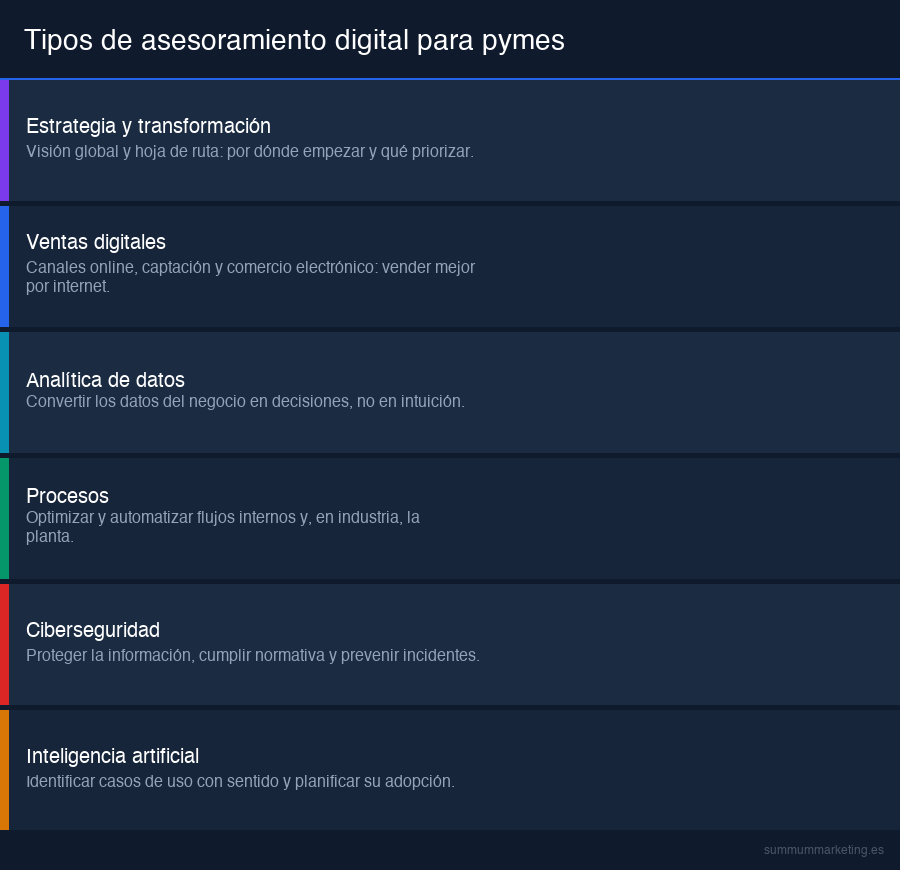
What types of digital advisory exist?
Digital advisory is not one single thing: it specializes by area, because an SME's problems vary depending on where the pressure lies. This classification covers the most common and useful types, and largely matches the categories funded by Kit Consulting, which gives an idea of which are most in demand.
| Type of advisory | What it focuses on | Question it answers |
|---|---|---|
| Strategy and digital transformation | Global vision: where to start, what to prioritize, medium-term roadmap. | "How do I digitalize without wasting money or losing direction?" |
| Digital sales and marketing | Online channels, customer acquisition, digital presence, e-commerce. | "How do I sell more and better online?" |
| Data analytics | Turning business data into decision-making information (dashboards, KPIs). | "How do I stop deciding by gut feeling and start using my data?" |
| Business or production processes | Optimizing and automating internal flows, management and, in industry, the plant floor. | "How do I do the same work with fewer errors and less time?" |
| Cybersecurity | Protecting information and systems, regulatory compliance, incident prevention. | "How do I prevent an attack or breach from shutting down my business?" |
| Artificial intelligence | Identifying meaningful AI use cases and planning adoption. | "What is AI actually useful for in my case, and where do I start?" |
Most SMEs do not need all of them at once. The effective approach is to identify the current bottleneck and start there. A good advisor will in fact typically discourage opening five fronts simultaneously: they prioritize whichever will deliver results fastest and build from there. That prioritization is the difference between useful advisory and a catalog of good intentions.
How does advisory differ from training?
This is a frequent source of confusion and worth clearing up, because the two are sometimes mixed into the same project. Training's objective is to make your teams know how to do something: use a tool, apply a technique, handle a program. Advisory's objective is to decide what to do: whether that tool fits, in what order to tackle things, what to discard.
A simple example illustrates the point. Imagine an SME that wants to "use AI." Training would teach them to operate a specific generative AI tool. Advisory, by contrast, would first analyze which of that company's processes benefit from AI in practice, what data needs to be organized, and where to start so the investment does not simply chase a trend. Both are useful, but they answer different questions — and order matters: first decide, then train and execute.
How is digital advisory funded? Kit Consulting
Digital advisory has a cost — it is expert work — and this is where public support comes in. In Spain, the Kit Consulting (Spain advisory grant) program, managed by Red.es with European funds from the Recovery Plan, funds precisely this type of service for SMEs with between 10 and fewer than 250 employees. It works through a voucher that the company spends by contracting advisory from an accredited digital advisor, within a catalog of categories that largely matches the types we have seen.
The figures give a sense of its scale: the total voucher reaches up to €12,000, €18,000 or €24,000 depending on company size (10–49, 50–99 or 100–249 employees), and each advisory service has a maximum amount (for example, €6,000 in the artificial intelligence category). Important: the program funds the advisory — diagnosis and plan — not the subsequent implementation. To understand the full mechanics, start with the guide on what Kit Consulting is.
One detail to keep in mind: Kit Consulting operates through calls and available funds — it is not a permanent open window. In 2026, its continuity depended on the redistribution of surplus funds regulated by Orden TDF/38/2026. It is therefore worth checking the program's current status before counting on it.
How to choose the right digital advisory
Whether you fund it through Kit Consulting or contract it privately, a few key factors separate good advisory from advisory that delivers nothing:
- Start with the problem, not the tool. A good advisor asks "what hurts?" before proposing technology. Be wary of anyone who arrives with a solution before understanding your business.
- Request concrete deliverables. A clear diagnosis, a prioritized plan and a roadmap. If you do not know what you will walk away with at the end, something is wrong.
- Value sector experience. An advisor familiar with your type of company will tailor recommendations far more effectively.
- Distinguish advisory from selling. If the "advisor" only recommends products they also implement themselves, that is not advisory — it is sales. Good advisory is independent of the product.
- Do not open too many fronts. Better to resolve one area properly than five halfway. Prioritization is the first quality signal.
Digital advisory, done well, is the most cost-effective investment in the entire digitalization journey: the one that prevents all the other misguided investments. To go deeper into the catalog of areas and their nuances, see the piece on the full Kit Consulting advisory categories.
What does a digital advisory process look like, step by step?
To demystify it, it helps to see what actually happens when an SME hires digital advisory. Although every advisor has their own method, the journey typically follows four fairly recognizable phases:
- Diagnosis. The advisor analyzes the starting situation: how you work, what tools you use, where the bottlenecks are, and what your digital maturity level is in the relevant area. This is the listen-and-observe phase before proposing anything.
- Opportunity identification. With the diagnosis in hand, the points where technology can deliver the most value with the least effort are identified. Not everything that is possible is worthwhile; here, priorities are separated from secondary matters.
- Plan and roadmap. Opportunities are turned into an ordered plan: what to do, in what sequence, with what expected return. This is the core deliverable — the one the company will use to decide and execute.
- Support sessions. Much of the value lies in the sessions where the advisor explains the findings, answers questions and helps interpret the plan. A report without explanation delivers half its potential.
What distinguishes a good process from a mediocre one is the depth of the first phase. An advisor who takes time to understand your business before making recommendations will be far more accurate than one who arrives with off-the-shelf solutions. That is why, when evaluating advisory, pay attention to how much the advisor asks before proposing: it is the best quality indicator there is.
This journey is also exactly what Kit Consulting funds in each of its categories. Understanding it helps you know what to ask for and what to demand, whether you contract it with the public voucher or privately.
Frequently asked questions
What is digital advisory?
It is a professional service in which an expert analyzes your company's situation, identifies digitalization opportunities and designs a prioritized action plan. Its core value is judgment: deciding what to do and in what order. The typical deliverable is a diagnosis, a plan and a roadmap — not an installed tool. It is not implementation, not training, not technical support: it is the thinking-and-planning phase before investment, and done well it saves more than it costs.
What types of digital advisory exist?
The most common are: strategy and digital transformation (global vision and roadmap), digital sales and marketing, data analytics, business or production processes, cybersecurity, and artificial intelligence. Each addresses a different need and they largely match the categories funded by Kit Consulting. Most SMEs do not need all of them at once: the effective approach is to identify the current bottleneck and start there.
How does it differ from training?
Training aims to make your teams know how to do something (use a tool, apply a technique). Advisory aims to decide what to do (whether that tool fits, in what order to tackle things, what to discard). They are complementary but answer different questions, and order matters: first decide with advisory, then train and execute. Confusing them leads to teams trained on tools the business did not need.
How is digital advisory funded?
In Spain it can be funded through Kit Consulting (Spain advisory grant), a Red.es program with European funds from the Recovery Plan aimed at SMEs with between 10 and fewer than 250 employees. It works with a voucher (up to €12,000 / €18,000 / €24,000 depending on size) spent by contracting advisory from an accredited digital advisor, within a catalog of categories. It funds advisory — not implementation — and operates through calls and available funds, not on a permanent basis.
Sources
- Acelera pyme — Kit Consulting: advisory service categories and amounts by segment. acelerapyme.gob.es
- Red.es — Kit Consulting program (official description). red.es
- Recovery, Transformation and Resilience Plan — "Learn about the Kit Consulting program." planderecuperacion.gob.es
- BOE — Orden TDF/38/2026, of 26 January (amendment of Kit Consulting bases and surplus funds). BOE-A-2026-2069
Content prepared by Summum Marketing for angelortegacastro.com. For informational purposes only; amounts, categories and deadlines for Kit Consulting must be confirmed against the current call published by Red.es.