Artificial intelligence has moved from a large-corporation topic to a conversation happening in every SME (small and medium-sized enterprise). The problem is the gap between "I know I need to look at AI" and "I know what to do with it Monday morning." Many small businesses are paralysed between the noise — it will change everything, it is a bubble — and the lack of concrete steps. This guide is exactly that: a sensible order for starting with AI in an SME without wasting money or time.
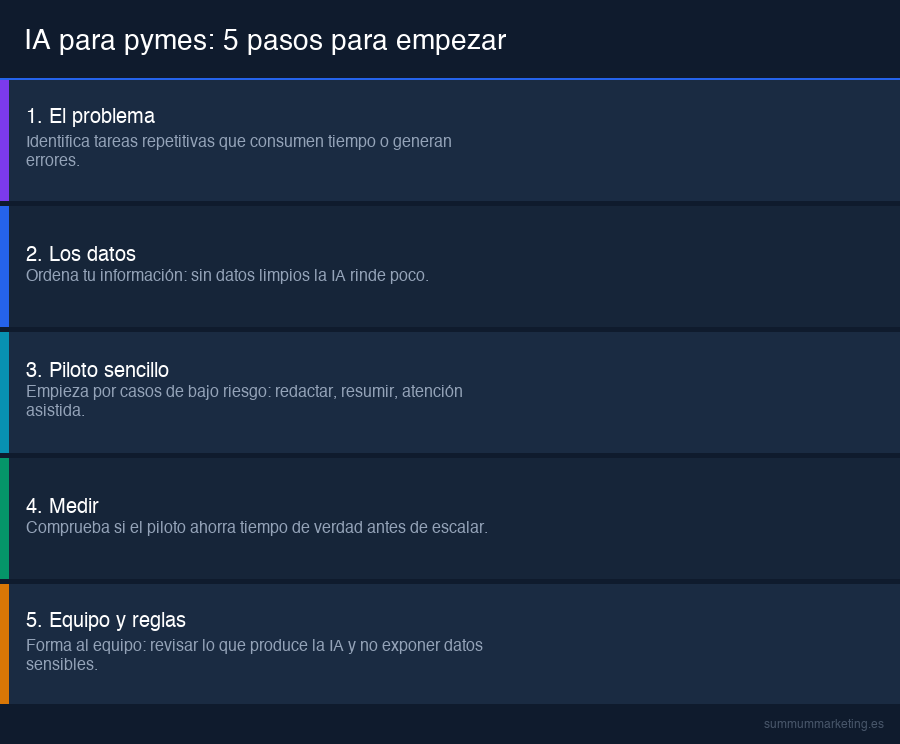
Where does an SME start with AI? Not with the tool, but with the problem. The sensible steps are: (1) identify specific tasks that consume time or generate errors; (2) organise your data, because without clean data AI performs poorly; (3) test simple, low-risk use cases first (writing, customer support, data analysis); (4) measure the result before scaling; and (5) train the team. Expert advisory — such as that funded by Kit Consulting (Spain advisory grant) — helps to prioritise and avoid the expensive mistakes of the early stage.
Before starting: AI is not magic, it is a tool
The first step is mental. AI is not going to "transform your company" simply by being installed, any more than buying a drill builds you a house. It is a powerful tool for specific tasks, and its value depends entirely on applying it to the right problems. SMEs that get value from AI are not those that buy the most technology, but those that have best identified which task they want to solve.
That is why this guide does not start by recommending any tool. It starts with the method, because order of operations matters here: those who start by choosing software end up with unused subscriptions; those who start with the problem end up with measurable results. Maintain that discipline and half the work is done.
Step 1: identify the problem before the tool
The starting question is not "what AI do I use?" but "what wastes my time, generates errors or costs me money repeatedly?" AI excels precisely at frequent, repetitive, text-, data- or image-based tasks. Make an honest list of your business's friction points and the candidates will appear.

Some questions that help identify them:
- What administrative tasks do we repeat almost identically every week?
- Where do emails, enquiries or documents pile up that someone has to read and classify manually?
- What decisions do we take "by gut" when we actually have data we are not looking at?
- What content (texts, responses, reports) do we produce routinely?
From that list come the first use cases. They do not need to be ambitious: the more specific and contained, the better for a start. For inspiration with real examples by department, the piece on AI use cases for SMEs will be useful.
Step 2: organise your data (the foundation almost nobody looks at)
Here is the step most often skipped and that causes the most problems. AI — especially AI that analyses your business — needs data to work, and needs it to be accessible and reasonably organised. If your information lives scattered across incompatible spreadsheets, emails and employees' heads, no AI tool will work miracles: it will work with rubbish and return rubbish.
It is not about launching a major data project before touching AI. It is about a reasonable minimum: knowing what data you have, where it is and whether it is reliable. In fact, organising data is itself part of the work that good AI advisory addresses, because without that foundation any use case is unstable. And there is a nuance worth remembering: as soon as AI touches customer or employee data, GDPR (General Data Protection Regulation) comes into play, so data governance is not optional.
Step 3: start with simple, low-risk use cases
The temptation is to go straight for the most impressive use case. The mistake is the same: starting with complexity multiplies the chances of failure and discouragement. The sensible strategy is to stagger, starting with what delivers quick results with little risk and little investment. This table orders use cases by entry difficulty for an SME:
| Level | Typical use cases | Why to start here |
|---|---|---|
| Entry (low risk) | Text drafting, email drafts, document summaries, translations, marketing ideas with generative AI. | Immediate results, low cost, does not touch critical systems or sensitive data. Ideal for the team to overcome their fear. |
| Intermediate | Assisted customer support (chatbots, suggested responses), email or document classification, basic sales data analysis. | Real efficiency gains in repetitive processes; requires some configuration and human supervision. |
| Advanced | Demand forecasting, predictive maintenance, large-scale personalisation, AI integration into the product. | Higher value, but requires solid data, investment and almost always advisory or bespoke development. Not for month one. |
The recommendation is clear: start at entry level, achieve a small but real win, and let that confidence take you to the next level. Generative AI (for writing, summarising, responding) is today the most accessible starting point for almost any SME, requiring virtually no technical investment. For specific applications, review the piece on practical AI applications in businesses.
Step 4: measure before scaling
A use case only deserves to grow if it demonstrates it works. Before extending AI across the whole company, measure the pilot: how much time does it actually save?, does it reduce errors?, does the team use it or abandon it after two weeks? This discipline avoids the most expensive pattern in SME AI adoption: accumulating tools "just in case" without knowing if they add anything.
Measuring also protects against enthusiasm. A tool can look impressive in a demo and not fit your real workflow. Only measured use on your own business will tell you the truth. If a use case passes the test, scale it; if not, discard it without regret and try another. That fast, cheap rotation is the healthy way to progress.
Step 5: train the team and define minimum rules
Technology without people who use it well is useless. Spend some time ensuring your team understands what AI is used for, what it can and cannot do, and where the limits are. A master's degree is not needed: it is enough that they know how to make use of the chosen tools and, above all, that they are clear on two golden rules.
The first: always review what AI produces. These tools make mistakes with confidence and aplomb; human judgement still governs. The second: do not put sensitive or confidential data into public tools without knowing how that information is handled. Two simple rules that prevent the two most common risks — errors and data breaches — and that any SME can implement from day one.
How much does starting with AI in an SME cost?
The good news is that starting costs very little. Many generative AI tools have free or low-cost monthly plans perfectly valid for entry-level use cases. The real initial investment is not money but time: the time to identify problems properly, test and measure. An SME can achieve tangible results with minimal financial investment if it chooses the right entry point.
Costs rise when moving to intermediate or advanced use cases that may require integration, organised data or development. And that is where expert advisory pays for itself: it helps you avoid buying what you do not need and guides you towards what actually moves the needle. In Spain, that advisory can be funded through Kit Consulting (Spain advisory grant), whose artificial intelligence service (with a grant of up to €6,000) is designed precisely to leave the SME with an AI adoption plan tailored to its business. This is developed in the piece on Kit Consulting AI advisory.
Mistakes to avoid when starting
- Starting with the tool rather than the problem. This is the root mistake from which almost all others derive.
- Trying to do everything at once. Five pilots at the same time means none finished. One done well is worth ten half-done.
- Skipping the data step. Without organised data, analytical AI does not work and generative AI makes more mistakes.
- Not measuring. Accumulating subscriptions without knowing if they add anything is wasting money with elegance.
- Blindly trusting AI. Without human review, errors slip into client communications and decisions.
- Ignoring GDPR. Putting personal data into any tool without thought can be costly in data protection terms.
Starting with AI in an SME is not complicated if done in order: problem, data, simple pilot, measurement and team. The hard part is resisting the temptation to skip steps, especially when the environment pushes you to buy the latest trending tool and show results as soon as possible. If you want to accelerate the journey with external expertise and avoid that sterile race, advisory such as that offered through Kit Consulting is the most cost-effective way not to stumble on avoidable mistakes and to start with a plan adapted to your business.
Frequently asked questions
Where does an SME start with AI?
With the problem, not the tool. The sensible steps are: identify specific tasks that waste time or generate errors; organise your data for AI to work with; start with simple, low-risk use cases (writing, summaries, assisted support); measure the pilot result before scaling; and train the team with two basic rules (always review AI output and never put sensitive data in public tools). Starting by choosing software leads to unused subscriptions; starting with the problem leads to measurable results.
What do I need to implement AI?
Less than you think to start and more judgement than most realise. For first use cases a generative AI tool and a well-defined problem are enough. What you really need: clarity on which task to solve, reasonably organised data if AI will analyse your business, someone to lead the tests, and basic usage rules. For advanced cases you do need solid data, integration and usually advisory or bespoke development.
How much does starting with AI cost?
Very little money: many generative AI tools have free or low-cost monthly plans valid for entry use cases. The real initial investment is time (identifying problems, testing and measuring), not budget. Costs rise for intermediate or advanced cases. In Spain, the advisory to plan that adoption can be funded through Kit Consulting (AI service with a grant of up to €6,000).
What mistakes should I avoid when adopting AI?
Six most common: starting with the tool instead of the problem; trying to do everything at once instead of one well-executed pilot; skipping the data step; not measuring whether pilots add value; blindly trusting AI without human review; and ignoring GDPR when putting personal data in public tools. Avoiding these is practically the whole difference between a successful and a failed AI adoption.
Sources
- Acelera Pyme — Kit Consulting: AI advisory service (amount and scope)
- Red.es — Kit Consulting programme (AI category)
- Recovery Plan — Kit Consulting programme
- AEPD — GDPR compliance for AI treatments
Content by Ángel Ortega Castro. Informational content; does not constitute product recommendation or personalised technical advice.