To access Kit Consulting (Spain advisory grant), companies had to be an SME with between 10 and fewer than 250 employees, with a registered tax address in Spain, be up to date with obligations (and not subject to the prohibitions in Art. 13.2 of Law 38/2003), and not exceed the de minimis aid limit. The voucher was spent with an accredited digital adviser. This is set out in Order TDF/436/2024.
Before considering any grant, the first question is whether your company qualifies. With Kit Consulting, Red.es's digital advisory programme, the requirements were clear but had several layers worth unpacking to avoid surprises. In this article I explain, based on the regulatory framework (the Order TDF/436/2024), what the programme required: company size, registered address, tax and administrative status, and the conditions for spending the voucher. This is an informational piece about programme mechanics: the application window is closed, so there is no "apply now" here — just an explanation of who could access and why, useful both for understanding the programme and for preparing eligibility for future calls for applications.
What Company Size Was Required?
The most defining requirement was size. Kit Consulting was aimed at SMEs (small and medium-sized enterprises) with between 10 and fewer than 250 employees, in line with the SME definition in EU Regulation No 651/2014. This excluded two extremes: self-employed individuals and micro-enterprises with fewer than 10 employees (who had Kit Digital as their route) and large companies with 250 or more employees.
Employee numbers were calculated from data on workers registered under the General Social Security Scheme and the Special Self-Employed Workers' Scheme (or any other legally valid method) at the time of application. Within that range, the programme defined three segments with different voucher amounts. Here is a summary:
| Segment | Number of employees | Voucher amount |
|---|---|---|
| Segment A | 10 to fewer than 50 | €12,000 |
| Segment B | 50 to fewer than 100 | €18,000 |
| Segment C | 100 to fewer than 250 | €24,000 |
I develop that segment and amount structure in more detail in my article on Kit Consulting segments, sizes and amounts. The segment determined how much voucher you had; the other requirements determined whether you could access it at all.
Which Companies Could Apply?
Beyond size, the regulatory bases required a set of eligibility conditions. These were the main ones:

- Tax address in Spain. Eligible beneficiaries were SMEs with a tax-registered address on Spanish territory.
- EU SME definition. Meeting the definition in EU Regulation 651/2014 — not just by employee count, but also by the turnover and balance sheet thresholds set out in that regulation.
- Not subject to exclusion provisions. Not incurring any of the prohibitions on receiving grants set out in Article 13.2 of Law 38/2003, the General Grants Act.
- No pending recovery orders. Not being subject to an outstanding European Commission recovery order for aid declared illegal or incompatible with the common market.
- Within the de minimis limit. Not exceeding the applicable de minimis aid ceiling, counting all aid received during the period set out in European regulations.
These requirements are standard for any Spanish public grant. What matters is that they were checked at the time of application, so eligibility had to be in order before applying — not after.
Is Being Up to Date with the Tax Authority Required?
Yes. As with virtually all public grants, companies were required to be up to date with their tax obligations (with the State Tax Agency and, where applicable, with regional or foral tax authorities) and with their Social Security obligations. This requirement derives directly from Article 13.2 of the General Grants Act, which lists the situations that bar a company from receiving a grant — including being in arrears.
In practice, this meant that a company with tax or Social Security debts could not access the grant until it regularised its situation. This is one of the points where most applications fail, so it is worth checking in advance: obtaining certificates of compliance and resolving any issue before starting the process.
In my experience with similar grants, the most common reasons for rejection are not size or registered address — which are easy to verify — but administrative details: a small Social Security debt the company thought had been settled, an expired certificate, or failure to correctly declare other de minimis aid. These are avoidable stumbles if documentation is prepared in advance. The practical recommendation is to treat eligibility as a closed checklist before moving any paperwork — not the other way around.
What Is the De Minimis Limit and Why Does It Matter?
The de minimis limit is one of the requirements that generates the most confusion and is most worth understanding. De minimis aid is public grant funding of limited value that European regulation allows to be awarded without prior notification to the Commission, on the basis that it does not distort competition. But there is a ceiling: the same company cannot accumulate de minimis aid above a certain amount over several financial years. Kit Consulting counted as de minimis aid, so if your company had already received other aid of this type (from other programmes, regional governments, or local authorities), you needed to add it up to check that the limit was not exceeded.
In practice, this was rarely a problem for a typical SME, but it could be an issue for companies very active in grant-seeking. For this reason, before applying it is worth maintaining an inventory of de minimis aid received in recent financial years. This is a calculation that an adviser or accountant usually handles, but one the company needs to be aware of to avoid an unexpected rejection.
The Requirement Many Overlook: the Accredited Adviser
Meeting the company eligibility requirements was necessary but not sufficient. The voucher could only be spent by engaging an Accredited Digital Adviser from the programme catalogue. Not just any consultancy qualified: the adviser had to have completed Red.es's accreditation process, which certified their capability and experience to provide services in the catalogue categories.
The arrangement was formalised through an Advisory Services Agreement between the beneficiary SME and the accredited adviser, setting out the scope, deliverables, and timeline. Without an accredited adviser there was no way to spend the voucher. To understand what the voucher was spent on, my guide on what Kit Consulting is and the overview of all Kit Consulting advisory categories are the right starting points.
Kit Consulting Requirements at a Glance
So as not to lose sight of the wood for the trees, this is the eligibility checklist I use with SMEs:
- Size: between 10 and fewer than 250 employees (EU SME definition under Regulation 651/2014).
- Address: tax-registered address on Spanish territory.
- Tax authority and Social Security: up to date with payments.
- Exclusion provisions: not subject to Art. 13.2 of Law 38/2003.
- De minimis: within the cumulative aid ceiling.
- Adviser: engaging an accredited digital adviser and signing the service agreement.
If your company met all six lines, it qualified for the programme. The complete legal basis for all these requirements is in the call for applications and regulatory bases published in the BOE, which I compile and annotate in another article in this cluster.
What If I Have Fewer Than 10 Employees?
This is a very common question, especially among self-employed individuals and micro-enterprises. Kit Consulting was not designed for them: its minimum threshold was 10 employees. For smaller businesses and the self-employed, the digitalisation grant route was Kit Digital (Spain digitalization grant), a separate programme that funded the implementation of solutions (website, e-commerce, management, cybersecurity) rather than strategic advisory. The two programmes should not be confused: Kit Digital pays for tools; Kit Consulting paid for consultancy. To understand the difference and which fits each case, see my comparison of Kit Digital and Kit Consulting, and the analysis of Kit Digital by sector to see how priorities change by industry. In my experience with SMEs in Castilla y León and Las Palmas, many companies at the 10-employee boundary gained clarity simply by understanding which programme they belonged to.
What About Future Calls for Applications?
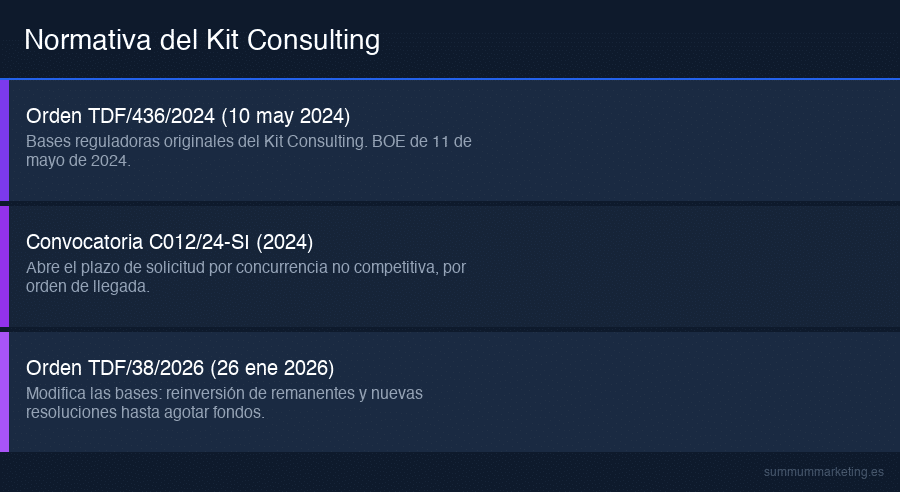
The application window for the original call for applications closed. It is worth knowing that in January 2026, Order TDF/38/2026 was published, amending the regulatory bases to allow the distribution of unspent funds not used in previous calls, with the aim of making the most of the programme's budget. That order, however, did not yet specify new deadlines or the reallocation procedure, which were to be developed through Red.es and Acelera Pyme instructions. For this reason, the sensible approach for an interested SME was — and remains — to have eligibility in order (size, address, up to date with payments, within de minimis) and stay alert to official communications, without assuming any reopening until it is officially published. I track the programme's status in my guide on the 2026 Kit Consulting digital advisory guide.
My advice is that, if your company fits the profile, do not wait for a call for applications to be announced before organising your situation. Having your tax and Social Security certificates up to date, calculating your de minimis position, and having a clear idea of which advisory category interests you is work worth doing even if the programme does not reopen: it prepares you for this grant and for any other, and forces you to think about your digital priorities ahead of time. Eligibility does not expire; the opportunity does.
Frequently Asked Questions
What are the Kit Consulting requirements?
The main ones were: being an SME with between 10 and fewer than 250 employees under EU Regulation 651/2014, having a tax-registered address in Spain, being up to date with tax and Social Security obligations, not being subject to the prohibitions in Article 13.2 of Law 38/2003 or having pending EU recovery orders, and not exceeding the de minimis aid limit. In addition, the voucher could only be spent by engaging an accredited digital adviser from the programme catalogue.
Which companies could apply?
SMEs with a tax-registered address in Spain that met the European SME definition (between 10 and fewer than 250 employees and within the turnover and balance sheet thresholds of EU Regulation 651/2014), provided they were up to date with their obligations and not subject to exclusion grounds. Self-employed individuals and micro-enterprises with fewer than 10 employees — who had Kit Digital as their route — and large companies with 250 or more employees were excluded.
Is being up to date with the tax authority required?
Yes. Companies were required to be up to date with their tax and Social Security obligations — a requirement deriving from Article 13.2 of the General Grants Act. A company with tax or Social Security debts could not be a beneficiary until it regularised its situation. Since this was checked at the time of application, it is worth obtaining compliance certificates and resolving any issues before starting the process.
What company size is required?
Companies with between 10 and fewer than 250 employees, calculated from Social Security and self-employment registration data at the time of application. Within that range there were three segments with different voucher amounts: 10 to fewer than 50 employees (€12,000), 50 to fewer than 100 (€18,000), and 100 to fewer than 250 (€24,000). The segment determined the available voucher amount.
Sources
- BOE — Order TDF/436/2024, Kit Consulting regulatory bases
- Red.es — Kit Consulting
- Acelera Pyme — Kit Consulting programme
- BOE — Law 38/2003, General Grants Act (Art. 13)
- Spain's Recovery, Transformation and Resilience Plan — Learn about Kit Consulting
Content by Ángel Ortega Castro. Informational content, updated as of publication date; programme status may change. Always verify with BOE and Red.es for current deadlines.